

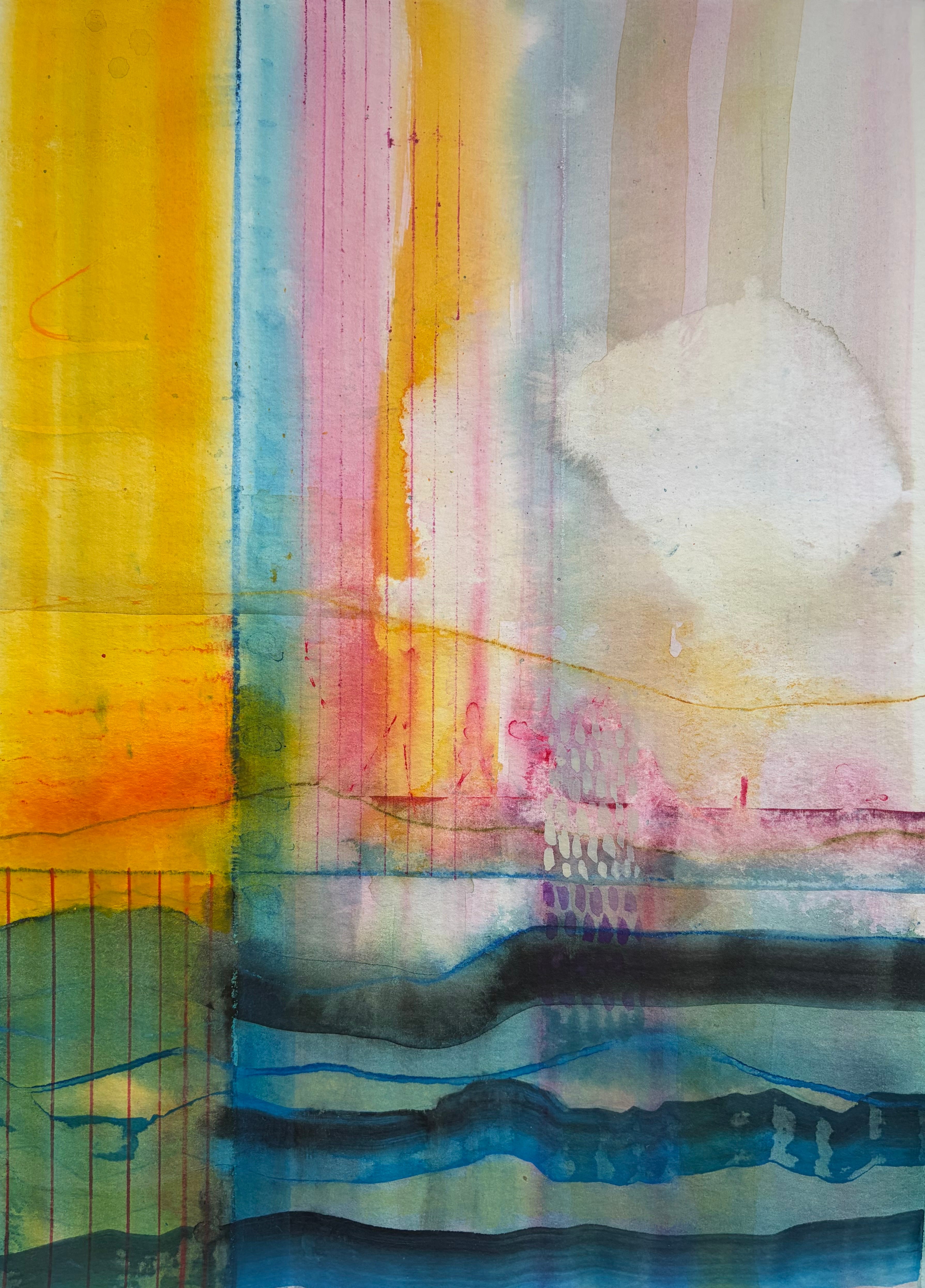
In my last post, I wrote about the experience of painting without knowing quite where it might lead. About allowing things to happen and sometimes discovering something I hadn’t anticipated.
Recently, while working on a series of paintings inspired by the Yorkshire Dales, something happened that made me think about this in a slightly different way.
I began to recognise the landscape in paintings I hadn’t consciously set out to make as landscapes.
And as they developed, they seemed to become something beyond the place that had inspired them.
The experience of a place
The series, Of All the Paths I’ve Walked, grew out of a recent visit to the Yorkshire Dales.
It’s a landscape that made a powerful impression on me.
I remember walking through the hills, the contours of the valleys, the stone walls and the changing weather. And particularly the light.
There were moments when the sky was almost completely overcast, then suddenly a break in the clouds would send sunlight across the landscape, illuminating a distant hillside or valley for just a few moments before it disappeared again.
But when I think back to Yorkshire, I don’t remember just the landscape.
I remember the car journeys, looking out of the window as the hills and fields passed by. The mornings, waking and looking through the bedroom window to see what the weather was doing. The sun rising and setting in the garden, the changing colours as the day came and went.
I remember the trees, the stone walls, the clouds and the wind. The sounds, the tastes, the feeling of the air, the textures of things encountered along the way.
And the paths themselves, of course. The experience of walking, of moving through a landscape rather than simply looking at it.
All these things have become part of my memory of the place.
Some memories are quite distinct. Others are less clear, almost impossible to separate from one another. They overlap and mingle, and I imagine many have stayed with me without my being particularly aware of them.
A place, after all, is never just one view.
It’s an accumulation of experiences, some vivid, some barely noticed at the time.
And I think that’s what I wanted to bring into these paintings. Not a particular view of Yorkshire, but something of what it felt like to be there.
What I began to see
When I started the paintings, I had the Dales very much in mind.
But I didn’t begin by drawing hills or valleys.
I worked intuitively, allowing the first layers of ink and colour to develop, then leaving them to dry.
It was when I returned to the paintings that something unexpected happened.
I began to recognise the landscape.
A sweeping form reminded me of the contour of a hillside. An area of colour suggested a distant valley. Certain marks seemed to carry something of the paths I’d walked.
And there were passages of light that brought back those extraordinary moments when sunlight broke through the clouds and illuminated the land far away.
I found this surprising because I hadn’t deliberately tried to create these references.
Perhaps they were already there, somewhere in the decisions I’d made without thinking too much about them. Or perhaps the paintings prompted me to recognise things I might otherwise have overlooked.
I don’t really know.
Probably a bit of both.
Once I’d begun to see these connections, I responded to them. I strengthened certain forms, introduced glazes, added lines of colour and developed references to the paths I’d walked.
But I wasn’t trying to turn the paintings into recognisable views of the Dales.
I was interested in what was emerging, and where it might take me.


More than a landscape
What I love about working this way is that a painting can begin to suggest so much more about an experience than any single view could.
When I think about my time in Yorkshire, there isn’t one image that captures it.
There are hundreds of moments. The changing light, the movement of the hills seen through a car window, the feeling of the wind, the sound of walking, the warmth of a pub, the colours of the sky at the end of the day.
And so much more that I probably couldn’t recall even if I tried.
I don’t believe all these things appear in a painting as recognisable images. Nor do I think every mark or colour has to represent something particular.
It’s much less literal than that.
But I do feel that something of this complexity can find its way into the work.
And then something else begins to happen.
The paintings start to become independent of the experience that inspired them.
A life of their own
As I progress through the series, I’ve been spending time looking at the paintings together.
And the more I look, the more I see them as having their own identities.
They still bring back memories of Yorkshire. I can recognise something of the place in them, and of my experience of being there.
But increasingly, I see the paintings themselves.
Their colours, their forms, their movement and energy. The relationships between different areas of the paper. The way one part seems to pull against another, or how a line or a passage of colour can change the feeling of the whole image.
They’ve become something beyond the landscape that inspired them.
And I love that.
It’s almost as though the paintings began with the intuition of a place, but gradually became expressions of something much larger.
Something about the extraordinary power of the world, the energy and complexity of everything around us.
I find this difficult to explain, and I’m not sure I could justify exactly what I mean.
But I feel it when I look at them.
I’ve been thinking about the British painter Patrick Heron, whose work and writing have interested me for many years.
Heron was deeply interested in the relationship between the visible world and the independent life of a painting. His paintings, often inspired by the light, colour and landscape around him in Cornwall, became works that existed on their own terms rather than simply representing what he saw.
I’m not suggesting that my paintings are like his. They belong to my own time, experiences and ways of working. But I recognise something in his understanding that a painting can grow beyond the things that first inspired it.
Perhaps that’s one of the things I find so compelling about painting. It can create something that doesn’t quite exist in words, something that has its own presence and can be experienced without needing to be explained.
Of all the paths I’ve walked
Looking at these paintings now, I can see how much of my experience of Yorkshire has found its way into them.
But they’ve also developed their own character, their own energy, their own presence.
And perhaps that’s why the title Of All the Paths I’ve Walked feels right to me.
It refers to the paths I walked in Yorkshire, of course. But it also suggests something about the journey of making the paintings themselves, the unexpected directions, the discoveries, and the places they have taken me.
I began with memories of a landscape.
I ended with a series of paintings that have become something of their own.
And I find that rather wonderful.