


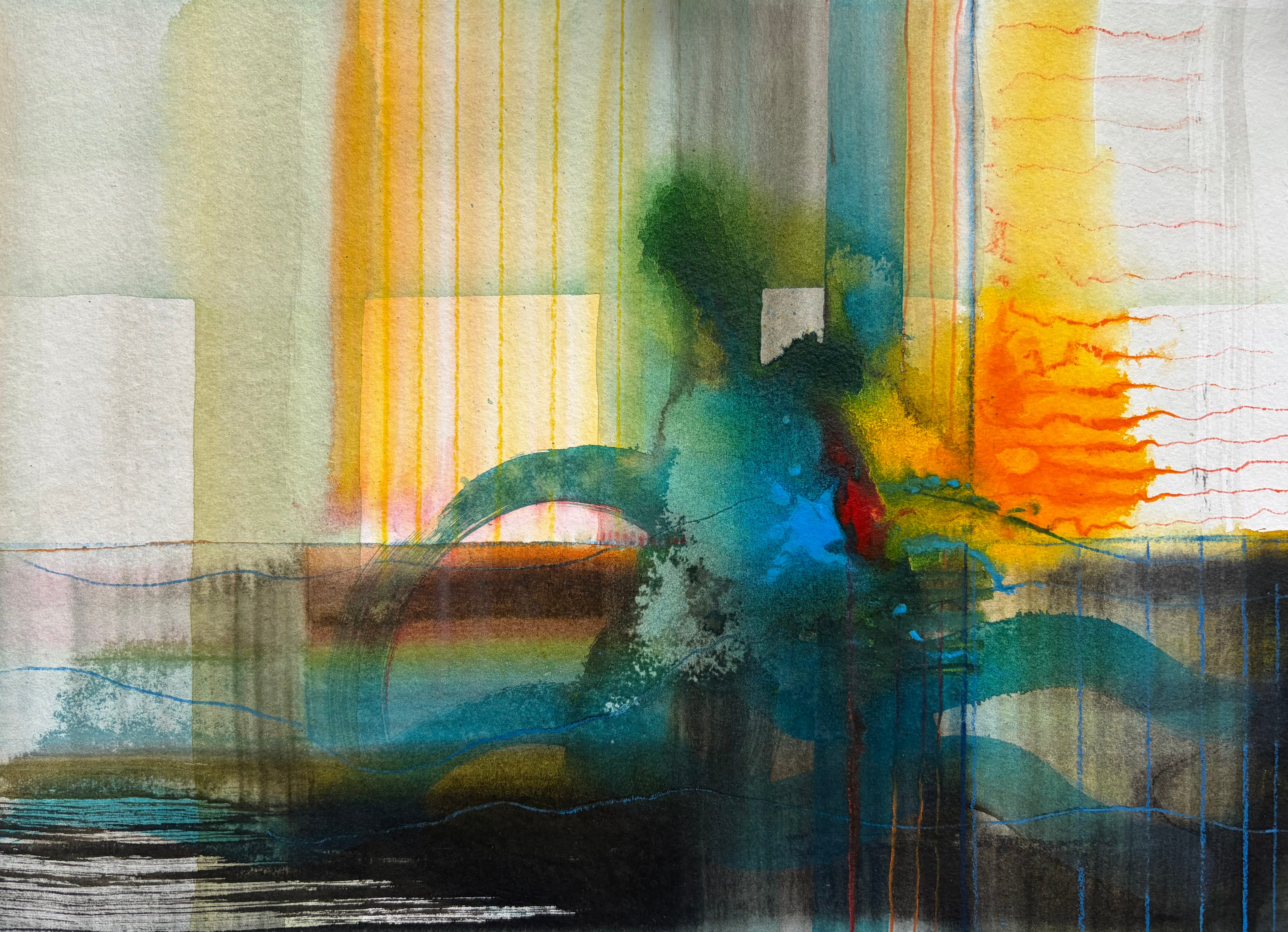
When I begin a painting, I haven’t got a clue where it’s going to go.
I usually start with some kind of structure, often a horizontal and vertical line across the paper. It gives me something to work from, although I have no idea whether those lines will still be visible by the time I’ve finished.
But before I even get to that point, there’s the business of preparing everything.
I suppose it’s a bit like cooking. You get your ingredients ready, make sure you’ve got the right pans and utensils, and organise everything so that when you start, you can just get on with it.
Painting is much the same for me.
I like my studio to be organised, with my paper, inks, pencils, brushes, water and sponges all within reach. I usually have other paintings around me too, reminding me of what I’ve done before and perhaps suggesting something about where I might go next.
There’s always a little anticipation before I begin. A slight nervousness, perhaps even a bit of adrenaline.
After all, I don’t know what’s going to happen.
And that’s rather exciting.
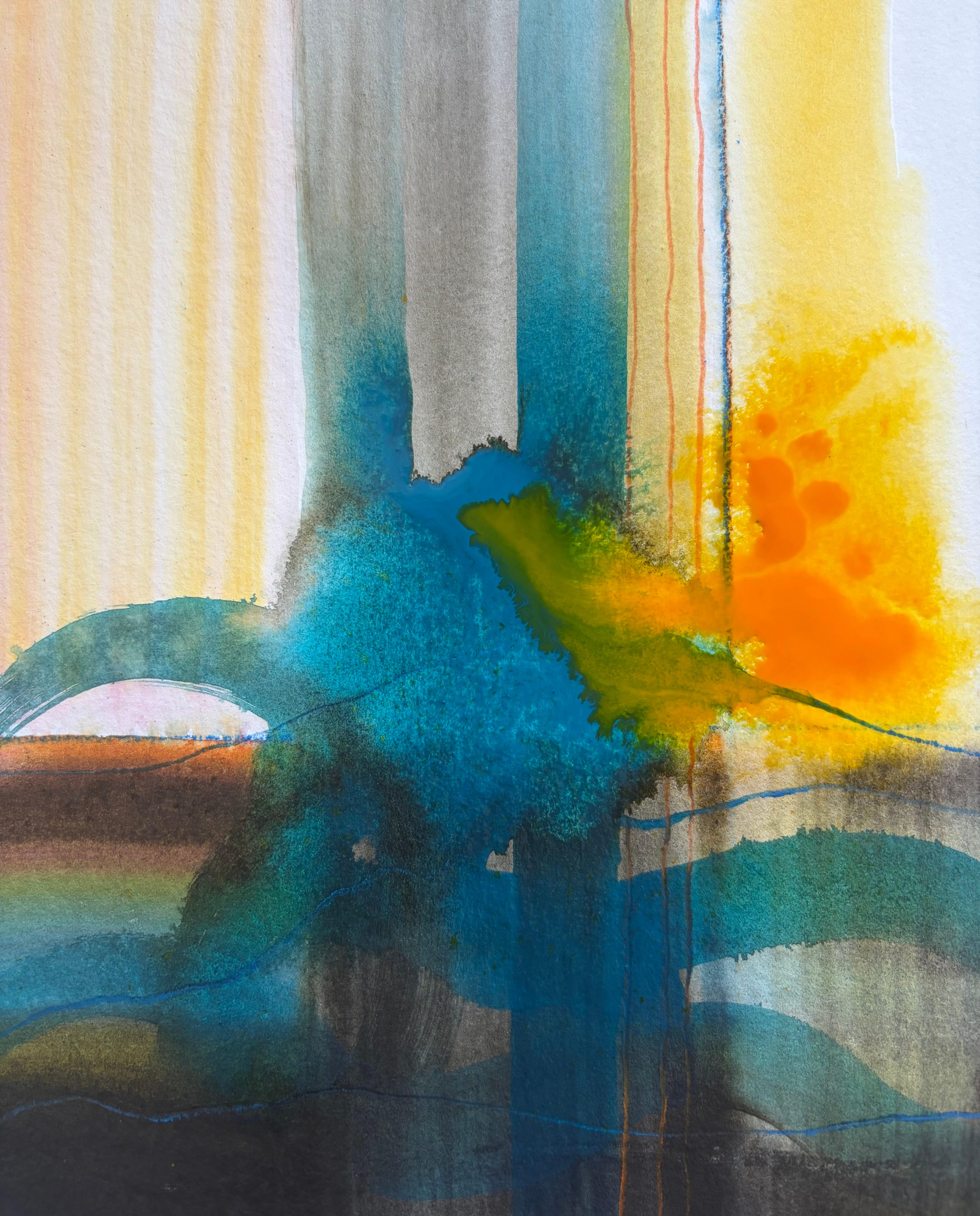
I particularly love working with water-based inks because they’re so unpredictable. You can introduce a little water and suddenly the colour starts spreading in a direction you hadn’t expected.
You can tilt the paper, blow the ink across the surface, blot it with a cloth or draw a brush through the wet colour.
Sometimes I’ll leave the ink to dry and then reactivate it with water, wiping some of it away and leaving behind a faint trace of what was there before.
I love that effect. It’s almost as though the paper has a memory.
I’ve recently been thinking about the paintings of Helen Frankenthaler, particularly the way she allowed fluid colour to spread and become part of the surface itself. Her work reminds me that the unpredictable behaviour of materials can be an important part of making a painting, rather than something we always need to control.
Of course, there’s a certain amount of control involved. I’m making decisions all the time.
Should I interfere? Should I leave it alone? Should I introduce another colour? Has something interesting happened, or have I made a complete mess of it?
But the decisions don’t seem to come from deliberate thinking.
It’s more of a feeling. An intuitive response to what’s happening in front of me.
I suppose it’s a kind of conversation between the painting and myself.
The materials do something unexpected, I respond, and that response creates another possibility.
It’s almost like learning a language.
And the curious thing is that I couldn’t really explain how I know what to do next.
I just seem to know.
When the mind gets in the way
One thing I’ve noticed over the years is how inventive the mind can be when you’re about to begin something.
Perhaps the light isn’t quite right. Perhaps I need better brushes. Perhaps I’m not feeling particularly inspired.
Or perhaps I’m simply kidding myself about being an artist in the first place.
There’s no shortage of reasons not to start.
But I’ve learned to recognise these thoughts for what they are.
Just thoughts.
And I don’t necessarily have to listen to them.
So I sit down and begin.
And something rather wonderful happens.
The thinking stops.
Or perhaps it’s more accurate to say that I stop being caught up in my thoughts. That constant internal dialogue seems to fall away, and I’m completely absorbed in what’s happening on the paper.
I’m not worrying about whether I’m making a good painting or what somebody else might think of it.
I’m simply responding to what’s in front of me.
And there’s a feeling that comes with that which I’ve often struggled to explain.
I feel as though I’ve arrived somewhere. As though I’m home.
It’s not really a feeling of excitement or even happiness, although happiness is a rather confusing word anyway.
It’s more a feeling of being at ease. Of being in the right place.
And I don’t mean physically. I mean internally.
I’ve spent much of my life searching for answers to some fairly big questions.
Why are we here? Why is there so much suffering? What’s the point of it all?
Not exactly questions that lend themselves to easy answers over breakfast.
The trouble is that searching can sometimes become part of the struggle itself. We’re always looking for something, trying to understand something, or imagining that the answer must be somewhere else.
But when I’m painting, that need to search seems to disappear.
It’s a little like returning home after a long journey. There’s a sense of relief. You can finally put your bags down.
And perhaps the curious thing is that you haven’t really arrived anywhere at all.
You’re simply here.
This is something I’ve come across in the writings of Eckhart Tolle, particularly his ideas about the difference between being aware of our thoughts and becoming completely absorbed in them. I’ve found that what he describes connects closely with something I experience when I’m painting.
It’s difficult to explain because, ultimately, it’s an experience rather than an idea.
I can describe what happens when I paint, but I can’t entirely explain the feeling that comes with it.
And perhaps I don’t need to.
Knowing when to leave things alone
Of course, things don’t always go smoothly.
Sometimes I become distracted. I start questioning what’s happening, worrying that’s often when things begin to go wrong.
I’ve learned that sometimes the best thing to do is stop.
Make a cup of coffee. Go for a walk. Leave the painting alone.
Sometimes I won’t return to it until the following day, or even several days later.
And something interesting happens when I do.
A painting that looked absolutely dreadful a few days earlier can suddenly reveal possibilities I hadn’t noticed.
Sometimes those paintings become among my strongest.
It’s not always easy to trust that process, particularly when you’ve spent hours working on something and it appears to have gone horribly wrong.
But I’ve learned that I don’t have to resolve everything immediately.
Sometimes the painting needs time.
Perhaps I do too.
Painting and the business of living
I’ve been interested in spiritual questions since I was quite young. I practised Buddhism in my early twenties, and I’ve always been something of a seeker.
During my years in Mexico, I began exploring these questions more deeply, particularly through the writings of Tolle and Michael Singer.
I became increasingly interested in the relationship between thought and awareness, and the possibility of being present without constantly getting caught up in what the mind is telling us.
Looking back, I can see how this has influenced my painting.
I’ve become more spontaneous, more willing to allow unexpected things to happen, and perhaps a little less concerned about knowing exactly where I’m going.
And I suppose there’s a connection with life itself.
We prepare as best we can. We make decisions. Unexpected things happen. Sometimes we intervene, sometimes we have to leave things alone, and sometimes the outcome is quite different from anything we could have imagined.
Of course, it’s much easier to trust that process when you’re sitting in front of a painting than when you’re dealing with the uncertainties of everyday life.
I’m certainly not suggesting I’ve mastered any of this.
Far from it.
But I’m beginning to think that life itself is a creative process.
And perhaps painting gives me an opportunity to experience that in a very direct way.
I prepare carefully, I begin, and then I try to allow things to unfold.
Sometimes it works. Sometimes it doesn’t.
But every now and then, when I’m sitting in front of a piece of paper watching the ink find its own way, there’s that wonderful feeling again.
That I’ve arrived.
That I’m home.